
When titanium earns its cost, how it behaves on a machine, and why most titanium parts are won or lost at the drawing review stage.
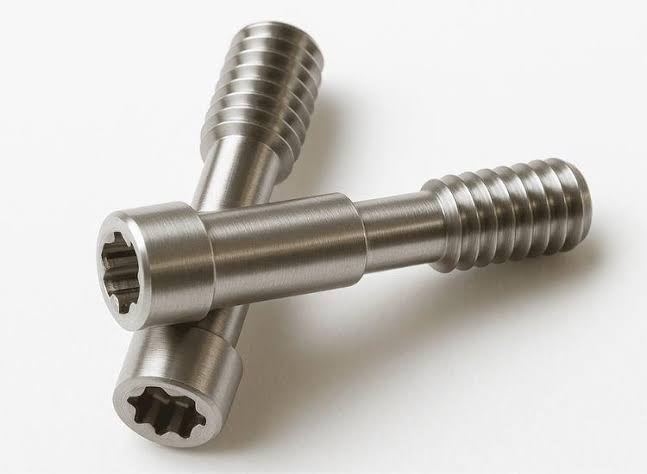
This page is the selection and machining reference. For the services that produce the part, see CNC machining →, Swiss machining → and precision grinding →
Titanium is chosen for one of three reasons, and it is worth being clear which one applies because they lead to different grades and different processes. The first is strength-to-weight: titanium alloys carry high load at roughly half the weight of steel. The second is corrosion behaviour, where titanium is unusually tolerant of seawater and chloride environments. The third is biocompatibility, where titanium and its alloys are well established in contact with the body.
Titanium is not chosen for cost. It is expensive as stock, slow to machine and hard on tooling, so a titanium part will cost several times the same geometry in aluminum or stainless. That premium is worth paying when the application genuinely needs one of the three properties above, and hard to justify when it does not.
Titanium is supplied in two broad families. Commercially pure grades are softer, more formable and chosen for corrosion resistance and ductility where high strength is not required. Alloyed grades add elements such as aluminium and vanadium to raise strength considerably, and are the normal choice for structural and load-bearing parts.
The grade we have documented engineering evidence for is Ti-6Al-4V ELI, an alloyed grade supplied to a lower interstitial specification. ELI stands for Extra Low Interstitial, and it is specified where improved toughness and fatigue behaviour matter alongside strength.
Grade choice interacts with the manufacturing route rather than sitting apart from it. The final condition, the specified surface finish, the tolerance on the finished part and whether the part will be machined before or after any heat treatment all change how the part is planned. Tell us the grade and the specification the part must meet, and we will confirm what we can hold against it.
Titanium has a reputation for being difficult, and most of that reputation comes from two properties. It conducts heat poorly, so heat generated at the cutting edge stays at the cutting edge instead of spreading into the chip and the part. That shortens tool life sharply and makes coolant delivery and feed control important rather than optional. It also tends to work-harden, so a tool that rubs rather than cuts leaves a harder surface behind and makes the next pass worse.
The practical consequences are consistent: sharp tooling, rigid setups, positive feeds that keep the tool cutting, and no dwelling in the cut. Titanium also has a low modulus of elasticity compared with steel, which means thin sections deflect and chatter more than the same geometry in steel. On long slender parts, support and workholding usually decide whether the tolerance is achievable.
Titanium is also chemically reactive at cutting temperature, which is why it galls and welds to tooling more readily than steel. That affects threading, tapping and any operation where the tool and the workpiece stay in contact under pressure.
The clearest titanium example on this site is a development project for Ivo, a US customer working on a urinary catheter device: a Ti-6Al-4V ELI retainer ring and a PA12 anti-pinch washer, starting with prototypes. That pattern — a small validation quantity first, a documented batch after — is typical of medical device work, where the documentation route is covered separately under ISO 13485 medical machining.
Two things about that project are worth generalising. The first is that the titanium component carried a specified surface-finish target of Ra ≤ 0.025 µm — a project target, not a statement of what every titanium part can be held to, and the case study does not report a verified measurement against it. The second is what the drawing review found: a risk of thread-crest damage where a threaded hole intersected a curved surface, which moved the discussion to entry geometry, engagement and alternative thread specifications before anything was cut.
Read the full Ivo titanium retainer project account →
The transferable point is that a titanium part is usually decided at drawing review. Grade, finish target, thread geometry and inspection criteria all need to be on the table before a route is chosen, because changing any one of them later is expensive.
Titanium finishing is normally about surface condition rather than appearance. Grinding and polishing are the operations used to reach a specified finish on functional surfaces, and they are planned as part of the route rather than added at the end. Because titanium holds heat at the cut, the finishing sequence also affects whether the final dimensions hold.
On scope, it is worth being precise. Our ISO 13485 certification was registered for the machining of hardware. It does not extend to product design, device assembly or device-level validation, and we do not present ourselves as an implant manufacturer. For medical-adjacent work we machine to the drawing and specification supplied by the customer. Certificate documentation available on request.
| Chosen for | Strength-to-weight, corrosion, biocompatibility |
| Cost | High stock cost, slow to machine |
| Machining | Heat at the edge, work-hardens |
| Stiffness | Lower than steel, deflects on thin walls |
| Main risk | Galling on threads and tappings |
| Availability | Grade and specification confirmed per RFQ |
Titanium leaves the least room for assumptions, so the drawing review matters more than on any other material.
The full list, with the reasoning behind each item, is in the CNC machining RFQ checklist.
Three reasons compound. Titanium stock costs more per kilogram, it machines several times slower because heat stays at the cutting edge and the material work-hardens, and tooling wears faster. The result is a higher cost per part even though the geometry is identical. Titanium earns that premium when strength-to-weight, corrosion behaviour or biocompatibility genuinely matter.
Ti-6Al-4V ELI, through a documented development project for a US medical-device customer. Grade and specification availability is confirmed against your drawing when we quote, so tell us the exact grade and the standard it must meet.
Grinding and polishing are used to reach a specified finish on functional surfaces, and they are planned as part of the manufacturing route rather than added at the end. What is achievable depends on the target, the surface it applies to, the geometry and how the result will be measured, so send the target with the surfaces it applies to and we will confirm what we can hold against your drawing.
Because the material leaves little room to recover. Grade, finish target, thread geometry and inspection criteria all influence the route, and changing one of them after the part is made is expensive. In the Ivo project the review caught a thread-crest risk where a threaded hole met a curved surface, which was resolved by discussing entry geometry and thread specification before any material was cut.
No. Our ISO 13485 certification was registered for the machining of hardware, and we do not present ourselves as an implant manufacturer. For medical-adjacent work we machine components to the drawing and specification supplied by the customer, and the scope of what we can support is stated on the certificate. Certificate documentation available on request.
Upload your CAD file with the grade, specification, surface-finish target and quantity. Our engineering team reviews manufacturability and comes back with a quote.