
Choosing between 303, 304, 316 and 17-4 PH, why stainless fights back in the machine, and the design decisions that keep it predictable.
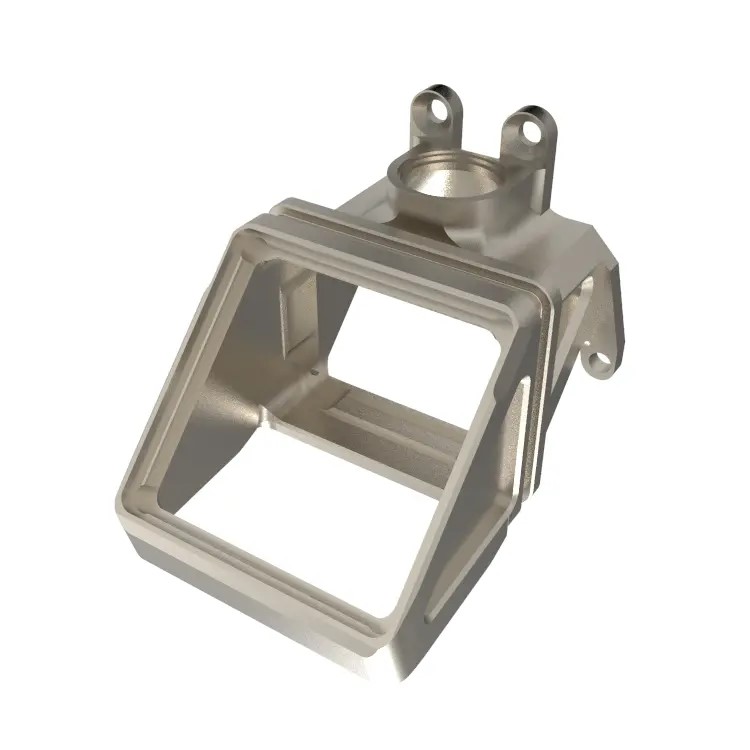
This page is the grade selection and machining reference. For the service itself, including the processes we run and how we inspect stainless parts, see CNC machining → and quality and inspection →
Stainless steel resists corrosion because chromium in the alloy forms a passive oxide layer on the surface. If that layer is scratched, it re-forms on its own, provided there is oxygen available and the surface is clean. This is why stainless is chosen for parts that see moisture, washdown, cleaning chemicals or repeated handling, and why it is not automatically the answer in every wet environment. The layer needs oxygen, so a stagnant crevice, a trapped chloride or a contaminated surface can still corrode.
Stainless grades differ in what they are good at, and the choice usually comes down to machinability, corrosion environment and whether the part needs to be hardened.
| Free-machining | 303 — sulphur is added to improve chip breaking, which makes it the easiest of the austenitic grades to machine. The same addition reduces corrosion resistance and weldability, so it suits parts that are machined, not welded, and not exposed to aggressive environments. |
| General purpose | 304 — the workhorse grade. Good corrosion resistance in most indoor, freshwater and food-adjacent environments, and it machines acceptably with the right tooling. Usually the first choice when a drawing says "stainless". |
| Chloride and chemical exposure | 316 / 316L — molybdenum is added, which improves resistance to chlorides and to some process chemicals. The low-carbon 316L is preferred where parts are welded, because it reduces the risk of sensitisation near the weld. |
| Strength and hardness | 17-4 PH — a precipitation-hardening grade. It can be machined in the annealed condition and then aged to a much higher strength, which makes it useful for shafts and structural parts that also need corrosion resistance. |
Grade and condition availability is confirmed against your drawing and specification when we quote. Hardened grades also change the machining route, so tell us the final condition and not just the material name.
Stainless is the material where machining experience shows most clearly. The alloy work-hardens: if the tool rubs instead of cutting, the surface gets harder as you go, and the next pass is worse than the last. The practical consequence is that feeds and depths are kept up rather than eased off, tooling stays sharp, and the setup has to be rigid. A light finishing pass with a dull tool is the fastest way to scrap a stainless part.
Stainless also conducts heat poorly compared with aluminum, so heat concentrates at the cutting edge and in the chip rather than spreading into the part and the fixture. That drives tool wear and makes coolant strategy more important. Chips are stringy rather than short, which affects chip evacuation on deep pockets and drilled holes.
The result is that stainless costs more per part than aluminum for the same geometry. It machines slower, tools wear faster and the process needs more attention. That is a consequence of the material, not of the shop.
"Corrosion resistant" is not a single property, and it is worth being precise about the environment before choosing a grade. The questions that actually decide it are: what is the part exposed to, how concentrated, at what temperature, and does the design create crevices where liquid can sit?
Tell us the service environment with the enquiry. It changes the recommendation more often than the drawing does.
Passivation is the finish most closely tied to stainless performance. It removes free iron and contaminants from the surface so the chromium oxide layer can form properly, and it is usually specified after machining or after any operation that could embed foreign material. Bead blasting gives a uniform matte appearance and polishing a brighter one. Electropolishing removes a thin layer of surface material and is used where a very clean, smooth surface is required.
For parts in regulated supply chains, note that our ISO 13485 certification was registered for the machining of hardware. It does not extend to product design or to device-level validation, so send the specification you need to be met rather than assuming a scope. Certificate documentation available on request.
| Corrosion basis | Self-renewing chromium oxide layer |
| Needs oxygen | Yes. Crevices are the weak point |
| Machining | Work-hardens, needs rigid setup |
| Heat behaviour | Poor conductor, heat at the edge |
| Relative cost | Higher per part than aluminum |
| Availability | Grade and condition confirmed per RFQ |
Stainless has more variables than aluminum, so these details change the quote more often.
The full list, with the reasoning behind each item, is in the CNC machining RFQ checklist.
304 is the usual choice for indoor, freshwater and general handling environments. Choose 316 or 316L when the part sees chlorides, salt spray, coastal air or process chemicals, and choose 316L where the part will be welded. The deciding factor is the service environment rather than the drawing, so tell us where the part will be used.
Stainless work-hardens, so tooling has to stay sharp and the setup rigid, which means slower feeds and more attention than aluminum. It also conducts heat poorly, so heat concentrates at the cutting edge and wears tools faster. Those are material properties rather than shop preferences, and they show up as higher cost per part.
Yes. 17-4 PH is a precipitation-hardening stainless grade we machine and grind, and it appears in our medical machining and Swiss machining material lists. Tell us whether the part is supplied in the annealed or aged condition, because the hardened condition machines very differently.
For most stainless parts passivation is worth specifying, because it removes free iron and contaminants so the protective oxide layer can form properly. It is usually required for medical, food-adjacent and hygienic applications, and it is a sensible default after any operation that could embed foreign material in the surface.
Yes. For welded assemblies we would normally recommend a low-carbon grade such as 316L to reduce the risk of sensitisation near the weld. Tell us which areas will be welded so the machining and finishing route can account for it.
Upload your CAD file with the grade, condition, quantity and finish. Our engineering team reviews manufacturability and comes back with a quote.