
Swiss-type CNC turning for small, high-precision parts. Guide bushing support eliminates deflection on long, thin geometries. Live tooling for cross holes, flats, and threads in a single setup. No MOQ.
Swiss-type CNC lathes are built for small, precise, high-aspect-ratio parts that conventional CNC lathes cannot hold tolerance on. The bar stock feeds through a guide bushing that supports the material at the cutting point, so the part does not deflect or bend as it gets longer. This lets us turn parts 10, 20, or 50 diameters long with consistent tolerance, which is impossible on a conventional lathe where the part hangs in free space.
Our Swiss lathes also have live tooling and sub-spindles, so cross holes, flats, keyways, threads, and back-side features can be machined in the same setup as the turning operations. That means no second operation, no re-fixturing, and no accumulated tolerance error between machines.
| Equipment | Swiss-type CNC lathes with sub-spindle and live tooling |
| Diameter range | Ø0.5–32 mm bar stock, subject to drawing review |
| Max length | Confirmed per RFQ — provide your part dimensions and we'll confirm fit. |
| Tightest tolerance | ±0.01mm turned |
| Live tooling | Yes, cross and axial |
| Sub-spindle | Yes, back-side operations |
| Certifications | Certificate documentation available on request. |
| Typical lead time | 10-20 days |
And why it matters for small parts.
On a conventional CNC lathe, the workpiece is held in a chuck or between centers and stays stationary while the tool moves along it. The material sticks out and is unsupported, so it bends under cutting force. The longer and thinner the part, the more it deflects. Past a certain length-to-diameter ratio, you cannot hold tolerance because the part is literally bending away from the tool.
On a Swiss lathe, the bar stock feeds through a guide bushing that grips the material just behind the cutting point. The tool cuts within a few millimeters of the bushing, so there is essentially zero unsupported length. The part comes out straight, round, and to tolerance regardless of how long it is. Then the bar feeds forward and the next section is cut, so long parts are produced by feeding and cutting in segments.
The result: parts that are small, long, precise, and consistent. Swiss lathes also run faster on small parts because there is less material to remove per part and the setup is optimized for bar-fed production. For high-volume small parts, Swiss turning is often the cheapest way to hit a tight tolerance.
| Swiss | Conventional | |
| Support | Guide bushing | Chuck/centers |
| Deflection | Near zero | Rises with length |
| Diameter range | Ø0.5–32 mm | Any |
| Best for | Small, long, precise | Larger, shorter |
| Throughput | High on small parts | Moderate |
We run both Swiss and conventional CNC lathes. Send the drawing and we will recommend the right machine based on the part geometry, not on which machine is idle.
Bone screws, dental implants, surgical pins, spinal cages, biopsy needles, catheter fittings. These parts are small, have complex thread forms or micro-features, and often need titanium or stainless steel. Swiss turning is the standard process for this category. See medical device manufacturing, or the Ivo titanium retainer development account for how a small medical component's thread and finish requirements get planned before a route is chosen.
Connector pins, contact terminals, sensor housings, valve bodies, threaded fittings. Small brass and copper parts that need high throughput and consistent tolerance.
Gauge pins, alignment shafts, valve stems, nozzle bodies. Parts where diameter tolerance and surface finish directly affect measurement or flow accuracy.
Fuel injector components, valve lifters, sensor fittings, precision shafts. High-volume parts that need consistent tolerance across thousands of units.
| Bone screws | Ti-6Al-4V, threads + hex |
| Dental implants | Ti Grade 4, micro-threads |
| Surgical pins | 316L stainless, passivated |
| Connector pins | Brass, high volume |
| Valve stems | 303/304 stainless |
| Gauge pins | Tool steel, hardened |
| Shafts | Aluminum or steel |
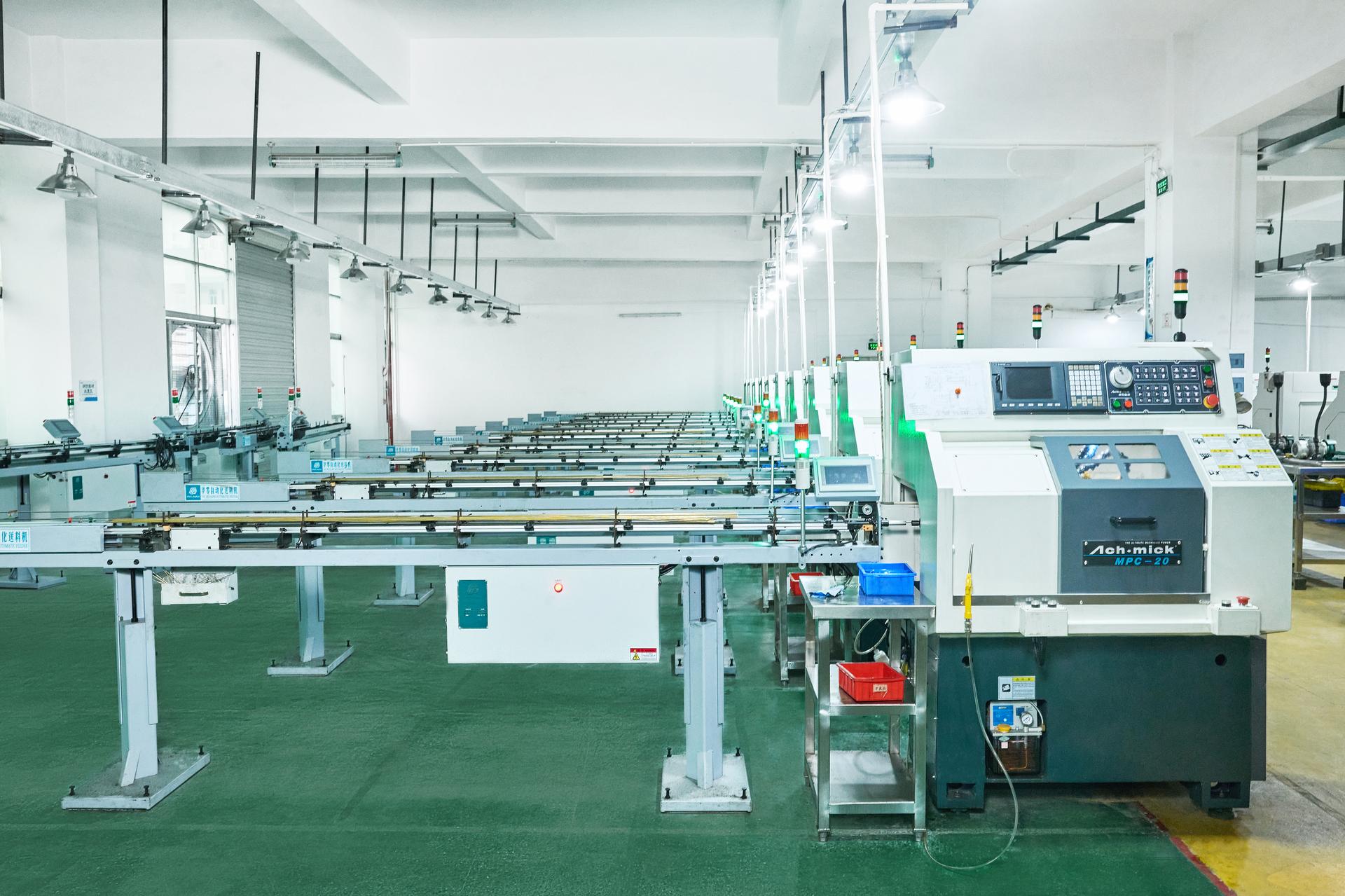
Swiss turning runs on bar stock rather than individual blanks. Our bar-fed lines keep cutting through a shift without an operator loading parts one at a time, which is what makes small-diameter work economical once you move past prototype quantities. Send the drawing and the quantity, and we will confirm which machine the part should run on.
Swiss lathes run on bar stock, so the material needs to be available as straight, clean bar. Most metals and many plastics are available in bar form. Here are the materials we Swiss-turn most often:
| Passivation | Stainless corrosion resistance |
| Electropolishing | Smooth, clean surface |
| Anodizing | Aluminum color/protection |
| Plating | Nickel, gold, tin, zinc |
| Polishing | Reflective or smooth finish |
| Heat treatment | Hardening, aging |
Swiss lathe machining is a type of CNC turning where the bar stock feeds through a guide bushing that supports the material at the point of cutting. This eliminates deflection, so long, thin parts can be machined to tight tolerance without bending. Swiss lathes also have multiple axes and live tooling, so complex features like cross holes, flats, and threads can be machined in a single setup.
Swiss lathes are ideal for small diameter parts (typically Ø0.5–32 mm) with high aspect ratios, complex features, or tight tolerances. Common parts include medical screws and pins, dental components, electronic contacts, valve components, miniature shafts, and watch parts. If your part is small, long, and precise, Swiss turning is likely the right process.
In conventional CNC turning, the workpiece is held in a chuck or between centers and the tool moves along a stationary part. In Swiss turning, the bar stock moves axially through a guide bushing while the tool cuts, so the material is supported right at the cutting point. This prevents deflection on long, thin parts and allows tighter tolerances on small diameters.
We machine titanium (Grade 2 and Grade 5), stainless steel (303, 304, 316, 17-4 PH), brass, copper, aluminum (6061, 7075), and engineering plastics including PEEK and Delrin on Swiss lathes. Material is fed as bar stock, typically Ø0.5–32 mm in diameter.
Our Swiss lathes handle bar stock from Ø0.5 mm to 32 mm in diameter. Parts smaller or larger than this range may be better suited to conventional CNC turning or other processes. Send the drawing and we will recommend the right machine for your part.
Yes. Our Swiss lathes have live tooling, which means cross holes, flats, keyways, and threads can be machined in the same setup as turning operations. This eliminates the need for a second operation on a separate machine, reducing cost and improving accuracy.
For parts above 32mm diameter or larger geometries, conventional CNC turning may be more suitable. See our general turning capability for the full range.
See CNC Turning →Send your drawing revision, material grade, quantity and required delivery date. Highlight critical features, finishing requirements and the inspection documents you need. Achievable tolerances depend on geometry, material and the manufacturing route; we confirm them against your drawing.
Upload your CAD file with material, quantity, and tolerance callouts. Our engineering team reviews manufacturability and comes back with a quote. No automated pricing tool, no shared sales inbox.