
When a PEEK part is worth the material cost, how it behaves on a machine, and the design issues that decide whether it holds dimension.
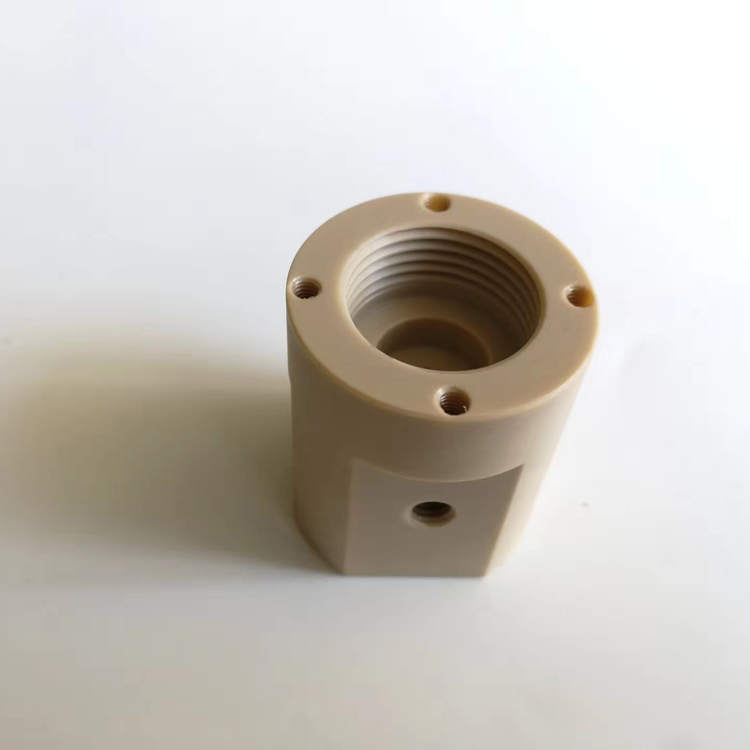
This page is the material selection and machining reference. For the service itself see CNC machining →, and for a wider view of machined plastics see all CNC materials →
PEEK is a high-performance thermoplastic, and it is specified when a part has to hold its shape and strength in conditions that would degrade a general-purpose plastic. The combination that makes it distinctive is that it retains useful mechanical properties at elevated temperature, resists a wide range of chemicals, and has low moisture absorption compared with nylons. It is also one of the few polymers that stands up to common sterilization methods, which is why it appears in medical-adjacent and analytical equipment designs.
None of that comes cheaply. PEEK stock costs many times more than POM or nylon, and it is harder on tooling. The right question is not whether PEEK is good, but whether the operating conditions actually require it. If the part runs at ambient temperature in a clean environment and does not need chemical resistance, a less expensive engineering plastic will normally do the job.
PEEK is supplied unfilled and in compounds with fillers such as glass fibre or carbon fibre, and the filler changes the material substantially rather than slightly. Unfilled PEEK is the more ductile and more chemically resistant option and machines more easily. Filled grades raise stiffness, improve dimensional stability and reduce creep, at the cost of being noticeably more abrasive on tooling and, in some cases, of chemical resistance.
The specific grade, its filler content and the documentation that comes with it are confirmed per order, because suppliers differ and the certificate matters as much as the material. Tell us the grade on your drawing, or the operating conditions if the grade is still open, and we will confirm what we can supply.
PEEK machines well with the right approach, but it is unforgiving of the wrong one. The two issues that cause most problems are heat and stress. PEEK does not conduct heat away from the cutting edge quickly, so excessive speed or a dull tool builds heat in the cut. Because the material is expensive, a scrapped part is a costly mistake rather than an inconvenience.
The second issue is internal stress. Extruded PEEK bar carries residual stress from its own manufacturing, and removing material releases it, which lets the part move after machining. On parts with tight dimensional requirements the usual answer is a stress-relief or annealing step before finishing, so the part settles before the final cuts rather than after. This is the single most common reason a PEEK part fails inspection, and it is a planning issue rather than a machining one.
Filled grades add a third factor: abrasion. Glass and carbon filled compounds wear tooling quickly and need sharper tools changed more often. They also tend to produce more dust, which is worth knowing if the part will be handled or cleaned afterwards.
PEEK is typically evaluated for machined components in a few situations, and it is useful to know which one applies to your part.
Whether PEEK is the right answer for a specific application is a decision for the customer's engineering team, and it depends on the service conditions. We machine to the material and specification on the drawing. If you are still selecting, tell us the conditions and we will tell you what we see from a machining and dimensional-stability point of view.
PEEK parts are normally used as machined. There is no anodizing or plating equivalent, and the as-machined surface is usually the finished surface. That makes the machining strategy itself the finish, which is another reason to agree the critical dimensions and the stress-relief approach before production starts. If a specific surface condition is required, describe it on the drawing and we will confirm what the machining route can deliver.
| Chosen for | High temperature, chemical resistance |
| Moisture | Low absorption, dimensionally stable |
| Machining | Machines well, heat-sensitive |
| Filled grades | Abrasive on tooling |
| Main risk | Residual stress, movement after machining |
| Availability | Grade and filler confirmed per RFQ |
Because the material is expensive and moves after machining, these details decide whether the part is right first time.
The full list, with the reasoning behind each item, is in the CNC machining RFQ checklist.
Extruded PEEK bar carries residual stress from its own production, and removing material releases it. The part then moves as it settles. The usual answer is a stress-relief or annealing step before the final cuts, so the movement happens before the finishing passes rather than after. It is a planning decision made at the start of the job, not something that can be corrected at the end.
Unfilled PEEK is more ductile, more chemically resistant and easier to machine. Filled grades raise stiffness, improve dimensional stability and reduce creep, but are noticeably more abrasive on tooling. The choice depends on whether stiffness and stability or toughness and chemical resistance matter more in your application. Tell us the grade on your drawing and we will confirm what we can supply.
PEEK is one of the polymers normally evaluated for parts that must survive repeated sterilization and still hold dimension, which is a large part of why it is specified in medical-adjacent and analytical equipment. Which sterilization method is compatible with your part, and how many cycles it must survive, is a decision for your engineering team. Tell us the requirement and we will machine to the specification on the drawing.
Yes. Documentation requirements are confirmed with your quote. Tell us what the certificate needs to state, for example the grade, the filler content and the supplier lot, so it can be matched to what the stock supplier provides.
No. You can start with a single part to verify fit, finish and dimensional stability before committing to a batch. On PEEK that first part is also the cheapest way to confirm the stress-relief approach is right for your geometry.
Upload your CAD file with the PEEK grade, operating temperature and quantity. Our engineering team reviews manufacturability and comes back with a quote.