
What POM actually is, how homopolymer and copolymer differ, and how to design precision plastic parts that hold dimension.
This page is the material selection and machining reference. For the service itself see CNC machining →, and to compare against other machined plastics see all CNC materials →
The names are used loosely, and it is worth being precise because the distinction affects what you get. POM is polyoxymethylene, also called acetal, and it is the material family. Within that family there are two chemistry types: acetal homopolymer and acetal copolymer. They machine similarly but differ in stiffness, chemical resistance and long-term behaviour in hot water and alkaline environments.
Delrin is a trademarked brand name for an acetal homopolymer, not a generic term for the whole family. A drawing that specifies "Delrin" is asking for that brand of homopolymer. A drawing that specifies POM or acetal may be satisfied by either chemistry type, and it is worth confirming which one the design actually relies on.
Tell us the grade on the drawing and we will confirm what we can supply. If the grade is still open, the operating conditions are enough for us to advise on the chemistry type.
POM earns its place in precision mechanical work because it holds a dimension and keeps doing it. It has low moisture absorption compared with nylon, so a POM part does not swell and shrink with humidity the way a nylon part can. It has a naturally low-friction surface, good wear behaviour against metal and against itself, and enough stiffness and toughness to work in mechanisms where a softer plastic would deform. It also machines cleanly and predictably, which is why it is a common choice for plastic parts that need metal-like precision.
POM is one of the easier plastics to machine well. It cuts cleanly, holds a sharp edge and does not tend to smear, and it can normally be machined without coolant. The two things to plan for are chip behaviour and stress. POM produces long stringy chips that tangle and can wrap around the tool or the workholding, so chip control is a real part of the process on deep pockets and long turning operations.
The second is internal stress, which behaves the same way it does in any extruded or moulded stock. Removing material releases stress and the part can move. On parts with tight dimensional requirements the answer is usually a stress-relief step before finishing, so the part settles before the final cuts.
POM is also sensitive to heat at the cut. It has a relatively low melting point for an engineering plastic, so excessive speed or a dull tool can generate enough heat to soften the surface or leave a poor finish. Sharp tooling and controlled feeds matter more than aggressive speeds.
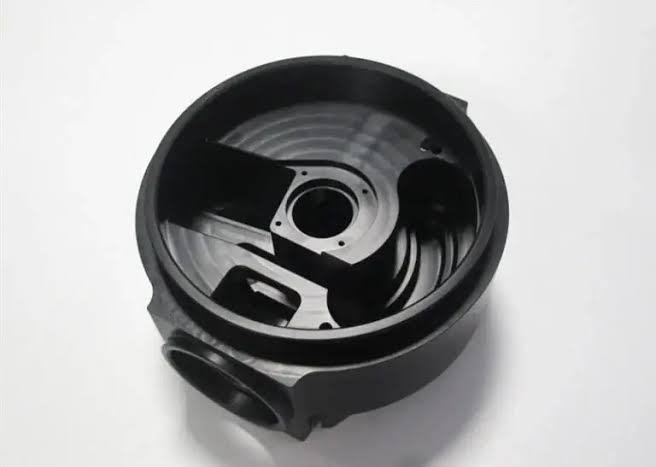
POM is typically evaluated for small precision mechanical components that need to slide, rotate or mesh repeatedly without binding: gears and gear segments, bushings and bearing sleeves, rollers and pulleys, wear strips and guides, valve and pump components, and precision housings and fixtures. The common thread is a part that needs dimensional accuracy and low friction at moderate load and ambient-to-warm temperature, where a metal part would be heavier or would need lubrication.
POM parts are normally used as machined, and the as-machined surface is the finished surface. There is no plating or anodizing equivalent, and painting is uncommon because adhesion is difficult on a low-energy surface. That means the machining strategy is the finish. If a specific surface condition or edge treatment is required, describe it on the drawing and we will confirm what the machining route can deliver.
| Family | POM, also called acetal |
| Chemistry types | Homopolymer and copolymer |
| Delrin | Brand name for acetal homopolymer |
| Moisture | Low absorption, holds dimension |
| Machining | Cuts cleanly, stringy chips |
| Main risk | Residual stress, heat at the cut |
For a precision plastic part, the grade and the operating conditions decide whether it holds dimension.
The full list, with the reasoning behind each item, is in the CNC machining RFQ checklist.
Not exactly. POM is the material family, also called acetal, and Delrin is a trademarked brand name for one type within it: acetal homopolymer. Acetal copolymer is a different chemistry with different behaviour in hot water and alkaline environments. If your drawing says Delrin it is asking for that brand of homopolymer; if it says POM or acetal, confirm which chemistry the design relies on.
Extruded or moulded POM stock carries residual stress, and removing material releases it, so the part moves as it settles. On parts with tight dimensional requirements the usual answer is a stress-relief step before the final cuts, so the movement happens before finishing rather than after. It has to be planned at the start of the job.
No, and that is one of the main reasons POM is chosen over nylon for precision parts. POM has low moisture absorption, so it does not swell and shrink with humidity to the same extent. That makes it more predictable in a dimensionally critical application, though it still expands with temperature.
Yes, POM is normally machined dry or with air blast rather than flood coolant. Chip control becomes the limiting factor instead, because POM produces long stringy chips that can wrap around the tool or the workholding on deep pockets and long turning operations.
No. You can start with a single part to verify fit, finish and dimensional stability before committing to a batch. On a precision POM part that first piece is also the cheapest way to confirm the stress-relief approach suits your geometry.
Upload your CAD file with the POM grade, operating conditions and quantity. Our engineering team reviews manufacturability and comes back with a quote.