
A water-clear optical SLA resin that combines transparency with genuine moisture resistance.
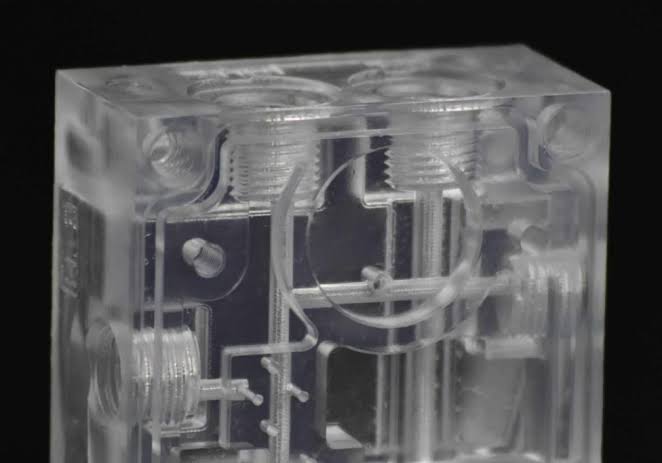
A water-clear optical SLA resin combining transparency with moisture resistance.
Strong optical transparency plus resistance to humidity affecting clarity.
Fluid-adjacent or humid-environment applications needing sustained clarity.
Fluid flow analysis models, automotive light pipes, packaging mockups.
Hand-polished clear finish achieves best optical results.
| Density | 1.10-1.15 g/cm3 |
| Typical Hardness | n/a |
| Typical Strength | 7,000-8,000 PSI tensile |
| Lead Time | Confirmed per RFQ |
| Finishing | Confirmed per RFQ |
Clarity in stereolithography is a property of the route, not only of the resin. A part comes off the machine with uncured resin on its surfaces, and that film scatters light, so a freshly printed part usually reads milkier than the same part after it has been cleaned, sanded and polished. Two parts printed from the same bottle can therefore differ noticeably in appearance if they were finished differently.
Water-clear grades exist because earlier clear photopolymers absorbed moisture and clouded, or crazed, when they sat near fluids or in humid air. The formulation resists that change so clarity holds up in service rather than only on the day of delivery. Clear photopolymer does still drift towards a warmer, yellower tone under prolonged ultraviolet exposure, so where a part is going outdoors or under strong lighting for months at a time it is worth stating that up front — it changes the advice on coating.
Water-clear resin suits parts whose job is to be seen through or to move light: flow-visualisation models, light pipes and guides, lens and sensor housings, packaging mock-ups, and display models where internal features have to be visible. In those cases the benefit is that a single printed part replaces a tooling investment that would only be justified at volume.
It is the wrong choice where the part has to survive impact, hold tight tolerance as a functioning component, or meet a defined optical specification. Where light has to be transmitted or shaped to a stated figure, or transmission has to be characterised across a spectrum, the part belongs on a machined or moulded optical route instead. For visual certainty alone, standard clear or tinted SLA resins are usually sufficient; for toughness without a transparency requirement, an ABS-like resin or SLS nylon is a better match.
Send the model through the RFQ form and an engineer will confirm the print orientation, the finishing route and the lead time in writing before anything is quoted.
Upload your CAD file, materials, and target quantity — we'll come back with a manufacturability review and a quote. Our engineers review every request personally.