
SLS nylon with added fire resistance, built for regulated flame-retardant applications.
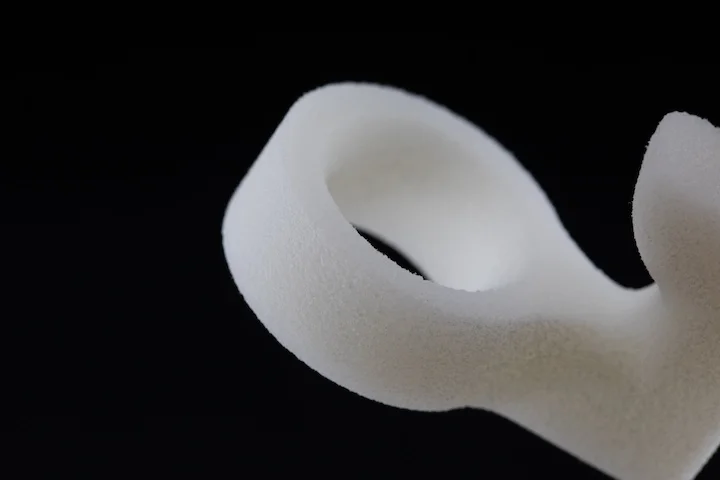
SLS nylon with added fire-resistance for regulated applications.
Same isotropic nylon strength with added flame-retardant performance.
Aircraft, transit, and electronics enclosures with flame-retardant requirements.
Aircraft interior enclosures, electronics cabinets, transit hardware.
Same no-support-needed SLS printing advantage as standard SLS nylon.
| Density | 1.0-1.05 g/cm3 |
| Typical Hardness | n/a |
| Typical Strength | 6,000-6,500 PSI tensile |
| Lead Time | Confirmed per RFQ |
| Finishing | Confirmed per RFQ |
A flame-retardant grade carries an additive package that changes how the material answers an ignition source: it takes longer to ignite and tends to self-extinguish rather than sustain a flame. That behaviour is a property of one specific grade at one specific wall thickness, measured by a defined test method. It is not a property of "nylon" in general, and it is not inherited by a different grade of the same family.
The practical consequence is that the rating belongs to the exact material you buy and the exact geometry you buy it in. Flame ratings are commonly specified against a recognised standard such as UL 94, and the level reached depends on both the grade and the thickness tested — so a rating quoted on a resin datasheet should be confirmed against the wall thickness your part actually uses. Where the requirement has to be demonstrated rather than stated, that is a test on the finished part, which is a different piece of work from a material certificate.
Flame retardancy is also narrower than it sometimes sounds. It is not heat resistance, not fire resistance, and not low smoke emission. Requirements written around smoke density or smoke toxicity — common in rail, marine and aircraft interiors — narrow the field to a much smaller set of materials, and it is worth saying so when you enquire rather than after a part has been built.
Flame-retardant nylon is normally reached for where an enclosure or bracket is going into a regulated product and the purchasing specification calls out a flame requirement for plastics: electronics housings and internal brackets, transit hardware and interior components, non-structural aircraft interior parts, and equipment enclosures that sit close to power or heat. In these applications the material decision is usually made once, early, because changing it later means re-testing the part rather than simply re-printing it.
Send the model through the RFQ form and an engineer will confirm the material grade, the process route and the documentation that comes with the order in writing before anything is quoted.
Upload your CAD file, materials, and target quantity — we'll come back with a manufacturability review and a quote. Our engineers review every request personally.